
MI–0005 Recorded September 3, 2026
Unspoken expectations become resentment
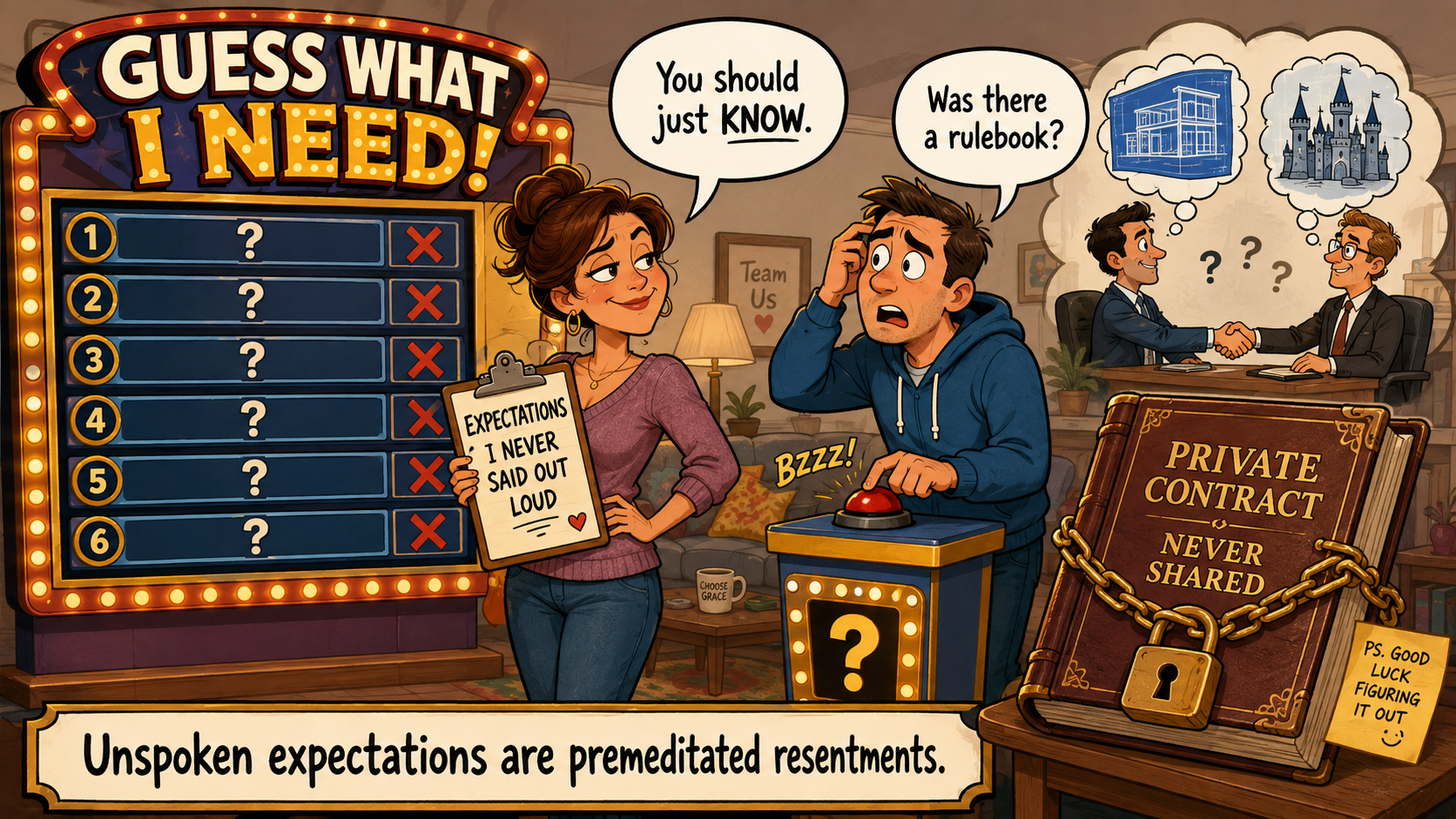
Unspoken expectations are premeditated resentments. Tell each other what you need and life will be a lot easier.
Refined insight
An expectation left unspoken is a resentment being prepared in advance; say clearly what you need.
The underlying insight
An unspoken expectation is effectively a private contract that the other person has never seen or agreed to. We decide internally what a partner, colleague, friend, or family member should do, then emotionally judge that person as though a mutual commitment has been broken when they fail to do it.
The word premeditated captures the self-defeating structure of this pattern. By withholding the expectation, we create conditions in which the other person is likely to disappoint us. We may then interpret that disappointment as evidence that they are inconsiderate, uncaring, lazy, or insufficiently attentive, even though they may simply have had different assumptions or no idea what we needed. In that sense, the resentment was prepared in advance by expecting mind-reading.
Application to marriage
This pattern can be particularly damaging in a marriage because each spouse accumulates countless assumptions about attention, affection, household responsibilities, money, sex, family obligations, and emotional support.
Tim’s observation is that, although either spouse can do this, women may be more inclined to communicate a need indirectly, hint at it, or expect a husband to recognize it without being told explicitly. When the hint is missed, the wife may experience the failure as lack of care, while the husband may be unaware that a request or test ever existed.
The larger principle is not dependent on that gender pattern: neither spouse should make the other’s ability to guess correctly the measure of love or commitment. The strength and prevalence of the proposed gender difference are not established within this entry and will vary substantially between individuals, couples, cultures, and circumstances.
Application to business partnerships
The same mechanism can cause serious conflict between business partners. Each partner may hold different assumptions about workload, authority, decision-making, compensation, reinvestment, risk, communication, working hours, standards of performance, and what happens if one person wants to leave.
Because these expectations can affect money, control, and ownership, relying on goodwill or shared enthusiasm is not enough. Important expectations should be discussed explicitly, tested with concrete scenarios, documented where appropriate, and revisited as the business changes. Clarity does not eliminate disagreement, but it reveals disagreement early enough to negotiate it instead of allowing it to emerge later as resentment or accusation.
The practical remedy
Say what you need, explain why it matters, and allow the other person to respond honestly. A clearly stated need is not a demand and does not guarantee agreement. The other person may be unable or unwilling to meet it. But the conversation converts an invisible expectation into something that can be understood, negotiated, accepted, declined, or compromised upon. That is far healthier than silently testing whether somebody cares enough to guess correctly.
The principle also cuts both ways. We should not assume that another person’s disappointment proves we knowingly failed them; they may never have told us what they expected. The useful distinction is between an expectation that exists only in one person’s mind and a responsibility that has actually been communicated, mutually understood, or firmly established by the relationship or circumstances.