
MI–0022 Recorded September 15, 2026
The Magic Trick to Getting Salespeople to Do Their Admin
Don't distract salespeople with admin tasks. Do it for them, then hold them accountable for hitting their targets and generating revenue.

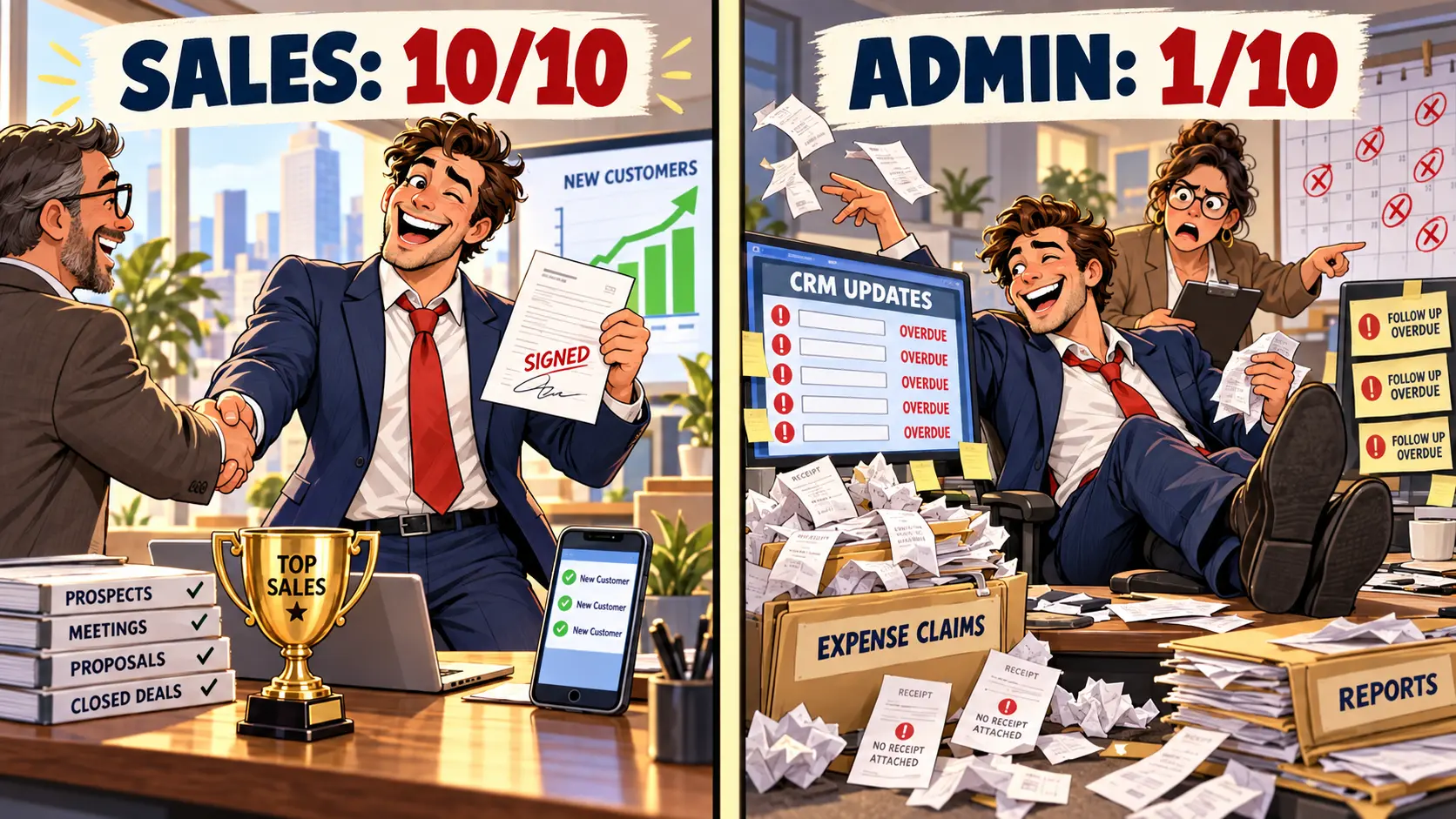
The best sellers were often the worst administrators
Across years of selling in England, continental Europe and America, Tim repeatedly finished as the top salesperson. He later managed teams ranging from five or six people to thirty-five. In different organizations and different markets, he kept seeing the same frustrating pattern.
Salespeople were bad at the supporting administration. CRM records were late or incomplete. Expense claims arrived without the right documentation. Reports were delayed. Promised follow-up disappeared into the busy day. And, in Tim's experience, the relationship often seemed almost perverse: the better somebody was at selling, the less reliable they could be at the paperwork surrounding it.
The administration still mattered. Without accurate CRM data, management could not forecast properly. Without complete reports, it could not see what was happening in the market. Without documented expenses and recorded follow-up, finance and customers inherited preventable problems.
The usual response was nagging, reprimands and penalties. It consumed management time and often landed hardest on the people bringing in the most revenue.
A persistent performance problem may be evidence of a badly designed job, not simply a badly disciplined person.
Stop trying to fix the wrong person
Once Tim became the manager, he stopped trying to turn every field salesperson into a conscientious administrator. Instead, he paired field representatives with inside salespeople whose job was to make the administration happen.
Finance pushed back. Its position was straightforward: the field salespeople were not doing their jobs, so management should force them to comply. Intel's traditional route to more revenue was also straightforward: hire more field salespeople. The budget existed for expensive field hires; Tim wanted permission to spend it differently.

His argument was not that CRM, expenses or reports were unimportant. It was that the scarce, economically decisive skill of a technical enterprise field salesperson was winning business. The supporting work required different strengths and could be performed better by somebody who cost roughly one third as much.
Approximate payroll comparison from Tim's recollection. The business question was return on the same hiring budget, not whether support cost nothing.
Thirty-five people in the field. Six people inside.
Tim built an inside team that regularly called the field representatives and asked for a complete rundown: meetings, opportunities, promises, changes, receipts and problems. The inside person updated the CRM, completed expense forms, clarified missing details, prepared reports and chased anything needed to finish the record.

The job went beyond data entry. If a client needed documentation, an order chased, sales material sent or a practical issue resolved, the field representative handed it over. The inside salesperson became responsible for ensuring that what had been promised actually happened.
Support was allocated by demand, not evenly. A top producer with a large opportunity pipeline might have nearly dedicated support. Lower-volume representatives could share one inside salesperson among several people. That made the model economical and put the most assistance where released time had the greatest value.
The result was not evenly distributed
The administration began getting done, more completely and on time. Customer follow-through improved. Salespeople recovered time for prospecting, relationships, negotiation and closing. Tim recalls that the sales improvement was strongest among the people who were already strongest at selling.
These are Tim's approximate retrospective estimates. The original reports are unavailable and his recollection alternates between conversion and revenue, so the figures should be read as remembered sales-performance gains, not audited measurements.
This shape makes economic sense. Giving one hour back to a low-volume seller may create a modest return. Giving the same hour to an exceptional closer with a strong pipeline can create far more revenue. Removing the same constraint from different people does not have to produce the same result.
Tim later used the model again with six field representatives and two inside salespeople and reports seeing the same general result.
The inside team became part of the selling system
The inside salespeople were rewarded partly through the success of the field representatives they supported. That changed the role. They competed to support strong producers, hunted for useful leads, pushed representatives to act quickly and chased the customer promises on which their own earnings now depended.
Tim remembers one inside salesperson taking back a neglected lead:
“I'm taking it away from you and I'm giving it to my other field salesperson because they follow up. Next time, if I give you a lead, I expect you to be on it immediately.”
To Tim, that was “music to my ears.” The system had created a miniature sales manager who protected the lead without waiting for Tim to notice, remind, escalate and remind again. It turned execution into a repeatable source of value and made the ownership of each action visible, a close cousin of giving every important action a clear thread.
When the system starts reinforcing itself
Tim calls this a positive feedback loop. The phrase does not need a scientific explanation. It simply means that one improvement helps create the conditions for the next improvement.
Positive feedback loops are powerful. If you create a positive feedback loop, you will go faster.
The loop also distributed management through the organization. Tim no longer had to chase every receipt, lead, CRM update and client promise himself. The inside salesperson had a reason to perform much of that supervision voluntarily.
Incentives are experiments, not commandments
Rewarding an outcome does not guarantee that people will pursue it in the way you intended. They may discover shortcuts, hoard attractive leads, attach themselves to the best performers or neglect somebody who needs development. That does not mean incentives are useless. It means the manager must watch the behavior the incentive actually creates.
This is why good CRM information and useful reports matter. They are not bureaucracy for its own sake. They let the manager see whether leads are being lost, whether customer promises are kept, which support relationships create results and whether an incentive has started producing the wrong behavior.
The objective is not to design a perfect scheme and walk away. A system that worked last year may not work next year. Flexibility is part of good management, not evidence that the original design failed. That is the same practical adaptability that turns optimism into useful action rather than blind confidence.
Redesign the accountability
Offloading administration does not remove accountability. It puts accountability where each role can carry it best.
Field salesperson
Revenue, targets, accurate raw information, customer commitments and prompt handoff.
Inside salesperson
Complete CRM records, documented expenses, reports, deadlines and promised follow-through.
Sales manager
Role design, information quality, incentive effects and whether the added support creates sufficient return.
Support cannot invent information the salesperson never supplies. The seller still has to pass along notes, receipts, commitments and changes. The support person needs clear authority to ask questions, pursue missing facts, complete the work and redirect neglected opportunities under transparent rules.
The core message
The lesson behind the trick
A sales manager's real job is to build systems that drive sales.
A sales manager's real job is not continually chasing individual salespeople. It is designing responsibilities, information flows, processes and incentives so that ordinary decisions by employees move the organization in the intended direction.
That means finding the scarce source of value, removing work that unnecessarily constrains it, pairing complementary strengths, measuring what actually happens and changing the system when the evidence changes.
Coaching and accountability still matter. They simply work better when the surrounding organization reinforces the behavior the manager wants instead of fighting it.
Create the system. Watch what it causes. Improve it. Then keep watching.