
MI–0023 Recorded September 17, 2026
Why Government Keeps Solving One Problem— and Creating Another
Unintended consequences are inevitable. The real dysfunction begins when government treats every solution as permanent instead of continuously measuring, testing and improving it.
Every system is a hypothesis.

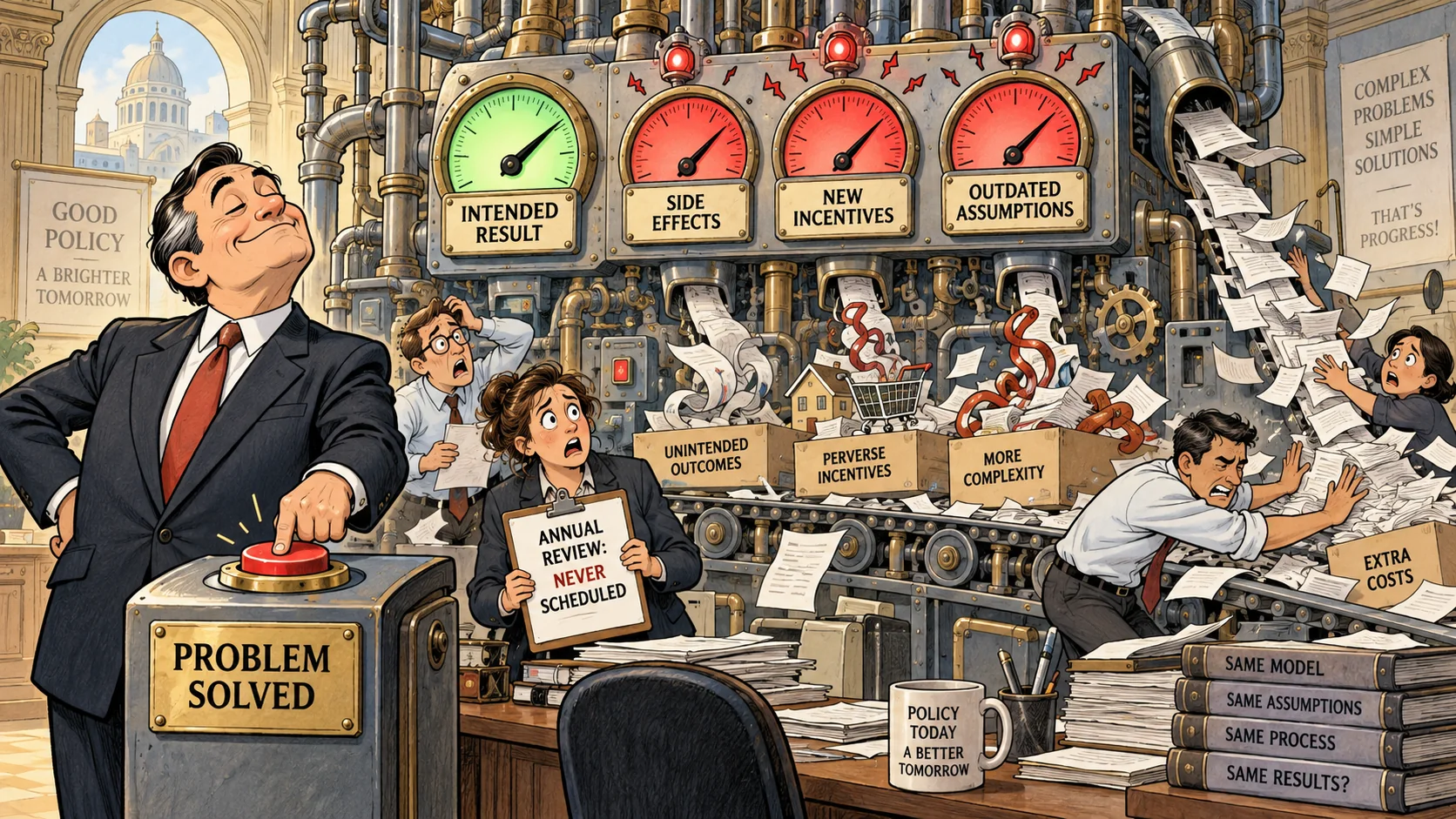
Why government solutions keep creating new problems
A committee studies a problem. Experts consult. Stakeholders negotiate. Lawyers draft. Legislators argue. Eventually a policy appears—and because so much effort went into producing it, the system is treated as finished.
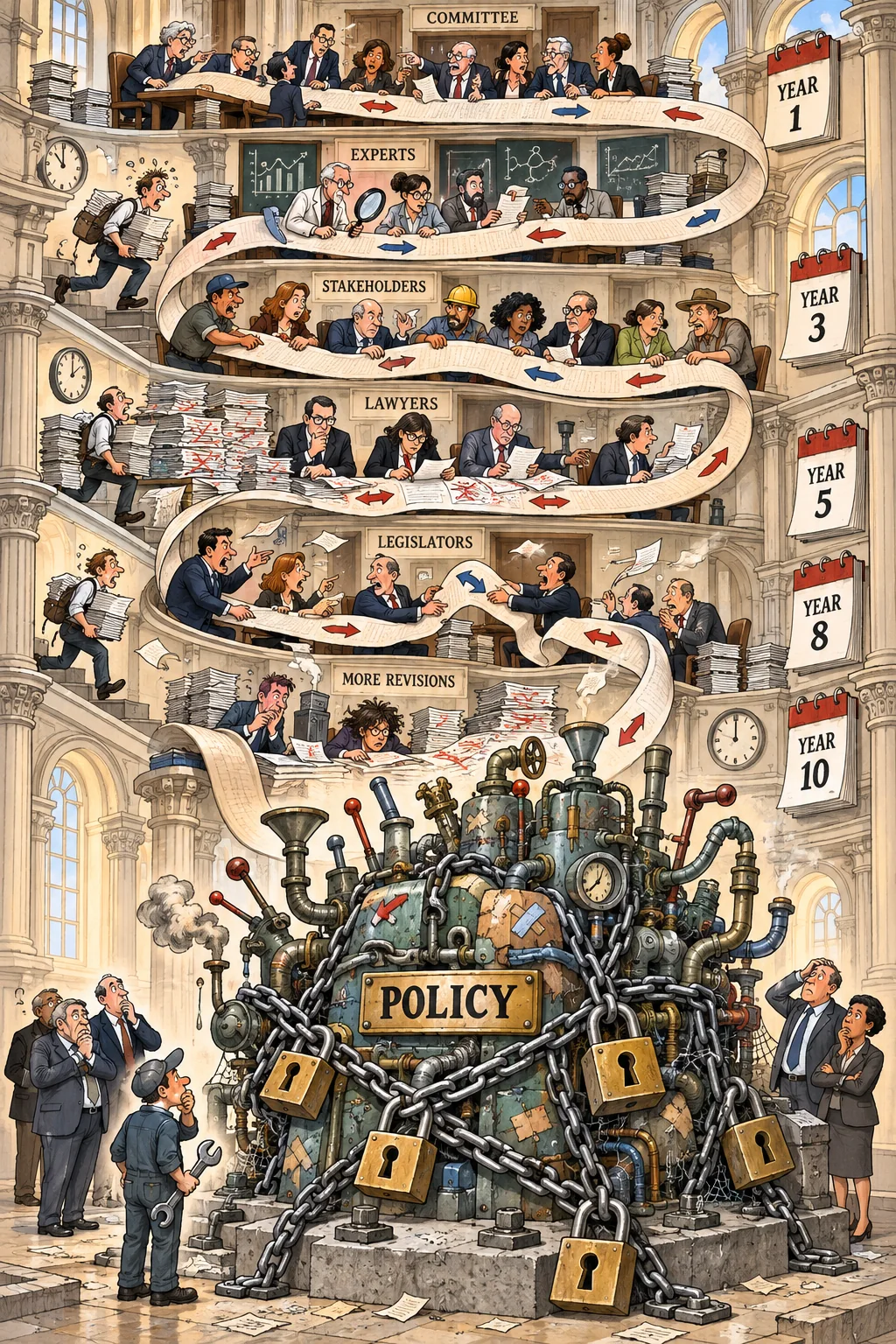
That is the deeper dysfunction. The mistake is not trying to improve society. It is thinking there is an end to the legislative process.
The human world is a complex adaptive system. People respond to rules, circumstances change, technology advances, new incentives emerge and yesterday's sensible solution begins producing tomorrow's problems. Passing a law should therefore be understood as the beginning of a live experiment—not the completion of a finished solution.
Evolution offers the obvious analogy. No animal becomes perfectly evolved and permanently stops adapting. A species may be well suited to its present environment, but when that environment changes, yesterday's advantages can become liabilities. A species incapable of adapting eventually disappears.
Government systems face the same reality. A law can be appropriate when introduced and increasingly unsuitable as the world around it changes. The central failure is that the legislative process is usually far too slow to observe, learn and respond. Even when harmful side effects become visible or the original circumstances no longer exist, revising the system can require years of political negotiation and procedural effort.
A successful legislative system would therefore build adaptation into the legislation itself: continuous outcome measurement, active monitoring for side effects, scheduled review and the authority to test and implement revisions. The objective is not to produce a perfect law. It is to create a system capable of becoming less wrong as reality reveals what the original designers could not foresee.
The objective is not to produce a perfect law. It is to create a system capable of becoming less wrong.
The problem is not that governments sometimes create unintended consequences. Every human system will. The failure is creating a system that cannot learn from them.
You fixed the problem. What did you break?
Most systems are monitored for process: Were the forms completed? Was the money distributed? Did the department follow the rule? Those questions matter, but they can all receive a reassuring “yes” while the real-world result gets worse.
Outcome monitoring asks harder questions. Did the policy achieve its stated purpose? Who changed behavior because of it? What new costs, dependencies, loopholes or risks appeared? Did it improve the measured target while quietly damaging something else?
Your system may be working. That can be the problem. It may be doing exactly what it was designed to do, while the design itself is creating results nobody intended.

A small system that created a 20% sales increase
In one of Tim's sales-management roles, marketing generated leads and distributed them to salespeople. The process looked complete: spend money, create demand, hand the opportunity to sales. But salespeople naturally cherry-picked. They pursued the leads that sounded large, immediate or appealing and sometimes neglected those that seemed less promising.
The marketing system had succeeded at delivering leads. It had not succeeded at ensuring those leads received a timely response.
Tim introduced a simple rule: if a salesperson did not follow up a new lead within roughly 24 hours, the lead was automatically reallocated to somebody else. The salesperson did not receive another reminder. They lost the opportunity.

Behavior changed quickly. The rule created urgency at the exact point where the original process leaked value. Tim estimates that it produced an approximately 20% increase in sales revenue without additional marketing expenditure or more salespeople.
Evidence boundary: The 20% figure is Tim's approximate retrospective estimate from the management role, not an independently audited experimental result. Its value here is the method: observe the real behavior, change the mechanism, measure again.
The system did not fail to influence behavior. It influenced behavior that its designers forgot to measure.
Government creates the same problem at national scale
Means-tested support for single parents exists for a compelling reason: children should not be left without food, housing or basic security because a relationship ended or a parent has limited income. But the formula can also create a household-formation penalty. If benefits fall sharply when a new partner moves in or contributes income, two adults may be financially worse off as one household than as two.
Tim experienced this tension personally when he and Sonja first formed a household. Cohabiting would have reduced her benefits, so Tim maintained a separate residence while spending much of his time with her. Local officials then investigated whether their arrangement met the government's cohabitation test. The system was trying to distinguish genuine need from incorrect claims. It also placed a financial and administrative barrier in the path of forming one household.
A 2023 evidence review commissioned by the UK Department for Work and Pensions found credible reasons benefits can discourage some couples from living together: reduced household income, loss of financial independence and the assumption that partners pool resources. It also found that the evidence base is limited and does not support treating benefits as the sole explanation for family structure.
The same caution applies in America. A wide-ranging review by economist Robert Moffitt concluded that the accumulated research is consistent with a non-zero welfare effect on marriage and nonmarital fertility, while estimates vary substantially. Benefits became less generous during periods when female-headed families continued to rise, which means they cannot plausibly be the only—or necessarily the dominant—cause.
Employment, wages, incarceration, concentrated poverty, relationship instability and many other forces also matter. Exposure to means-tested benefit rules is greater among lower-income households, so any household-formation penalty is likely to fall unevenly across communities. That supports investigating the incentive effect; it does not justify blaming single parents, welfare recipients or one racial group for a complex social pattern.
If a system makes the socially preferred choice more expensive, we should expect at least some people to make a different choice.
Good intentions are only version one
The answer is not to remove support and hope vulnerability disappears. Nor is it to assume the current formula must be preserved because its purpose is good. Protecting single parents and reducing the penalty for household formation can be pursued at the same time.
Possible hypotheses include a transition period when a couple forms a household, a gradual taper instead of a benefit cliff, a second-earner or partner-income allowance, continued protection of essential child benefits, or a household-establishment account that can help with a rental deposit, childcare, training, furniture, emergency savings or a first-home deposit.
Tim's initial idea was to offer an additional benefit when a single parent marries and the marriage lasts. The direction is useful: remove the system's one-sided financial penalty and give stable household formation some support. But a reward tied narrowly to remaining married for a fixed period could trap people in unsafe relationships, encourage premature marriage or create a new cliff to game. A better design would reward the formation of a financially stable household while preserving a safe exit from abuse or relationship breakdown.
None of these proposals should be declared the answer in advance. They are testable alternatives.
There is evidence that changing the structure can change outcomes. The randomized Minnesota Family Investment Program allowed working recipients to retain more assistance and changed the treatment of two-parent families. Evaluators found improved employment and poverty outcomes, increased marriage among some long-term single-parent recipients and greater marital stability among two-parent recipients. It was not a universal cure, but it demonstrated something crucial: benefit design is a variable, not a law of nature.
Every system is a hypothesis
A dynamic system begins with humility. The first design is the best current guess, not a monument. It is launched with a stated outcome, a side-effect register, measures that can falsify the theory and permission to change the rules when the evidence changes.
The review mechanism must be part of the original legislation, not an optional promise for a future government. That can include pilots before national rollout, public dashboards, independent evaluation, scheduled reviews, authority to adjust parameters within defined limits and sunset clauses that require evidence before renewal.
This does not eliminate democratic scrutiny. It changes what democratic scrutiny is asked to do—from pretending to predict every consequence before launch to agreeing on the objective, safeguards, measures and boundaries within which learning can occur.
Good intentions create the first version of a policy. Its consequences should create the next one.
Measure outcomes, not administrative motion
A serious review of a household-support experiment would not merely count payments or compliance checks. It would track disposable income, child poverty, employment, housing stability, household formation, relationship outcomes after the transition period, incorrect claims, administrative cost and the ability to leave unsafe relationships.
Those measures will sometimes conflict. One design may improve employment but increase housing insecurity. Another may reduce poverty while producing a costly new cliff elsewhere. The point is not to find a metric that makes the policy look successful. It is to see the whole result clearly enough to make an intelligent next change.
The same method applies far beyond welfare—to taxes, housing, healthcare, education, environmental rules, corporate incentives and the everyday systems inside a sales team.
The core message
A static system in a dynamic world eventually becomes wrong
Government often spends enormous effort trying to make the first decision perfect because changing it later is politically and procedurally difficult. A better process would spend less time pretending certainty is possible and more time building the capacity to learn.
That means every important system should have an owner for the outcome—not merely an administrator for the process. Somebody must be responsible for asking whether the objective still matters, whether the system is producing it, what else the system is causing and what should change next.
The larger insight is not that one benefit reform, one sales rule or one review schedule will be foolproof. It is that improvement comes from allowing hypotheses to compete, successful changes to proliferate and apparently successful systems to remain open to challenge.
Build the system. Watch what it causes. Improve it. Then keep watching.