
MI–0033 Published November 4, 2026 · By Tim Barrie
Will AI Make Your Children Lazy—or Show Them What They’re Capable Of?
The robot can do the homework. Or it can give the brain a workout. The difference opens a much bigger conversation about opportunity.
Use AI to exercise your thinking and expand what you can create.
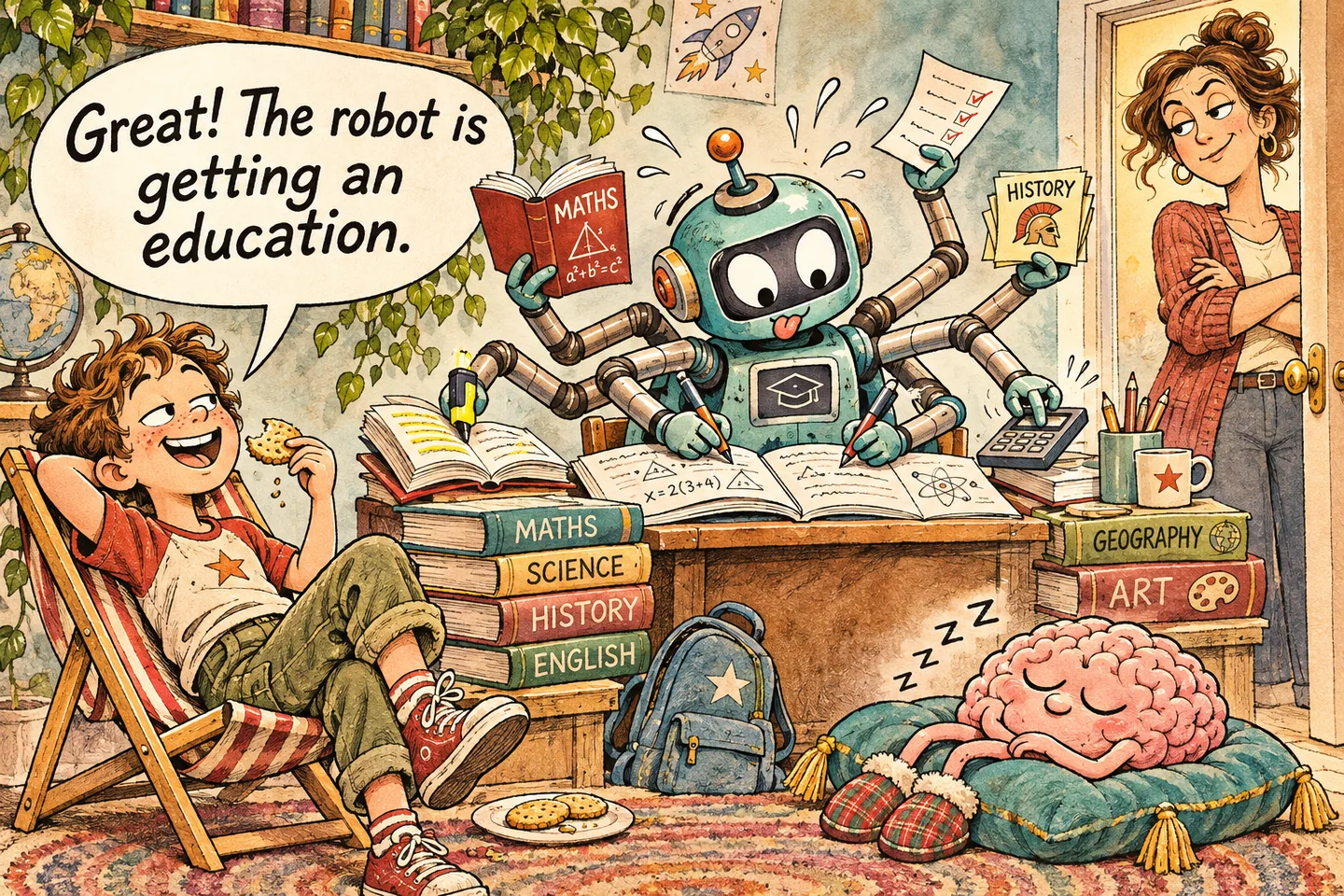
Who is getting the education?
A completed assignment and a more capable child are two different outcomes.
“Won’t children become dependent on AI and stop thinking for themselves?”
It is a reasonable concern. Imagine a child asking a chatbot to do the homework, copying the answer and heading off to play. The assignment is complete. The child may have learned very little. Somewhere, a tiny brain is putting on its slippers.
Now imagine the child asking the same AI: “Question me about what I studied. Don’t give me the answer. Make me explain it.” Suddenly the technology is asking the learner to do more mental work.
That difference deserves as much attention as the risk. How we use AI can shape both how much we learn and how much we believe we can achieve. As AI is like magic in a box explores, the interesting part is what we choose to do with the capability.
Close the book. Open the questions.
Familiarity can feel like learning. Recall puts that feeling to the test.
You read a chapter. You read it again. You underline the important bits. By the fourth reading, every sentence looks reassuringly familiar. Surely you know it now?
Then someone asks you to explain it without looking.
The uncomfortable silence is useful information.
Practising retrieval means trying to bring information back from memory. In learning experiments, repeated retrieval has improved delayed recall compared with repeated study. Research with science texts has also found benefits on questions testing understanding and inference. See Karpicke and Roediger’s retrieval study and Karpicke and Blunt’s science-learning study.
This does not make reading or note-taking useless. They help you encounter and organise ideas. But feeling familiar with a page is a poor substitute for finding out what you can explain when the page is closed.
AI offers a convenient way to organise that practice: ask questions, wait for an answer, give feedback and revisit the difficult parts. The learning principle has research behind it; the quality of a particular AI tutoring session still depends on its questions, accuracy and how the learner participates.
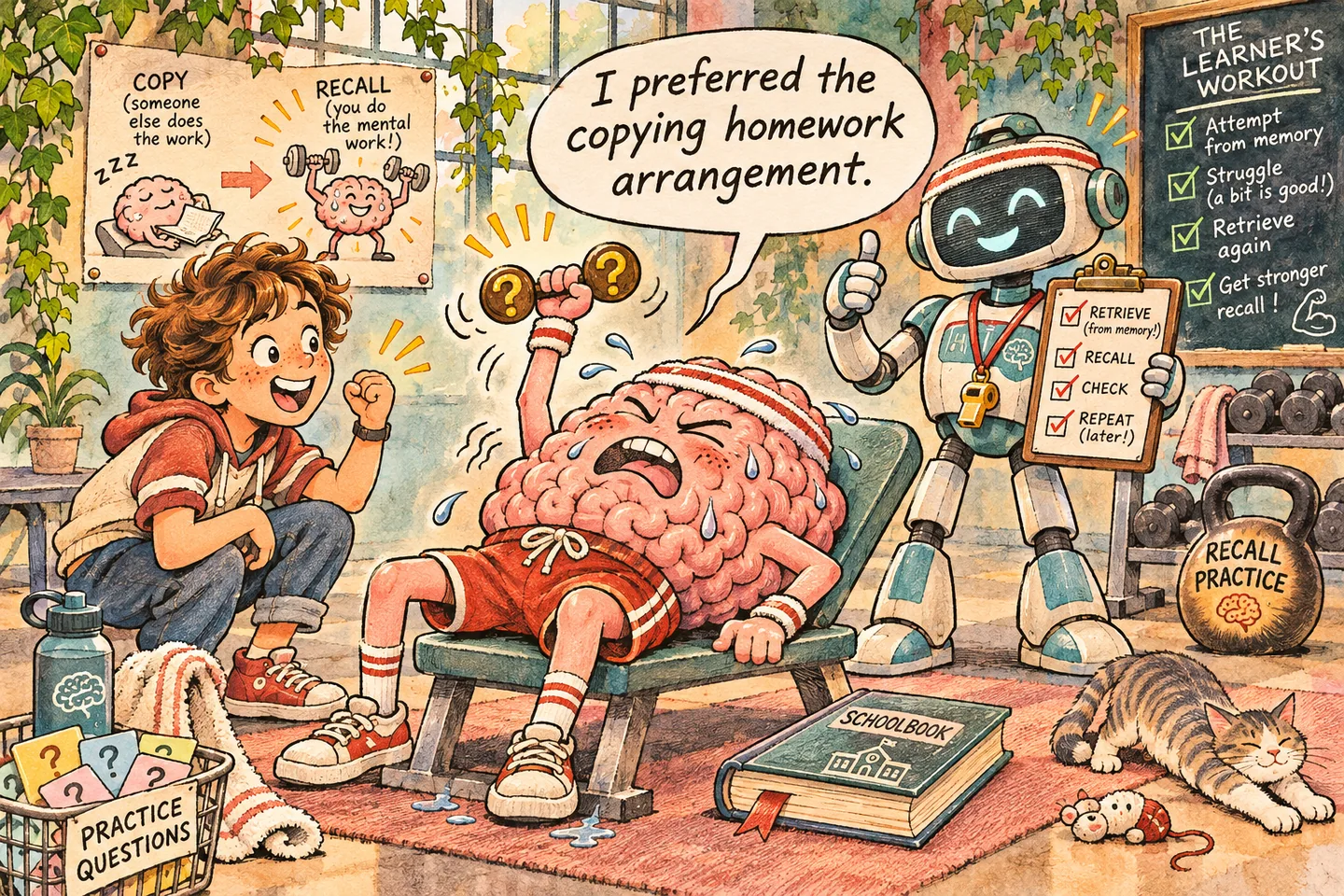
Give the robot a whistle
Ask AI to coach the learner through the thinking.
After a class or a study session, use the actual lesson notes or a short passage as the starting point. Specify the child’s age, school level, language and what they have covered. Age is a useful guide, but their answers should help set the difficulty.
Here is a prompt a parent can adapt:
My child is [age] and has just studied [topic]. Use the lesson material below. Ask one question at a time, suited to their current level. Wait for an answer from memory before offering help. Ask them to explain their reasoning. Mark the answer correct, partly correct or not yet correct, and explain why using the lesson. If they struggle, offer a hint before giving the answer. Have them try again in their own words. Include a question that applies the idea to a new example. Finish with what they understood and what needs more practice. Flag anything you cannot confidently check against the lesson.
For the water cycle, begin with “What happens to a puddle on a warm day?” Then try “Where did the water go?” Later, ask how that connects to water droplets on a cold glass. The aim is to connect ideas, not merely collect correct words.
Return to the difficult questions the next day and again later. Let the child explain the topic to you without the screen. A simple score can show progress, but the explanation matters more than a badge from a chatbot.
Use age-appropriate tools and supervision, follow school rules, and check doubtful feedback against the lesson or with the teacher. AI can confidently mark an answer incorrectly. A second chatbot’s agreement is not independent proof.
The useful question is: can the child now do something with the idea that they could not do before?
The kitchen table just got a bigger job description
AI can lower the cost of trying an idea.
There is another half to this story. We can spend so long asking whether AI will make people lazy that we overlook what it might help them become capable of doing.
Think back 10, 20 or 40 years. A person with an idea might have needed a programmer, a designer, a researcher, a writer and enough money to hire them. Or they needed years to learn several of those skills themselves. Many ideas never made it past “I wouldn’t know where to start.”
AI can now help with parts of that work: exploring a problem, comparing approaches, drafting material, writing code and developing an early prototype. People still need to judge, test and improve the result. But the distance between “I wonder…” and “Let’s try…” can become much shorter.
I see that as a powerful equalizing force. It does not erase differences in money, access, time or support. It does put useful capabilities within reach of people who could not previously assemble a whole team.
The opportunity is larger than doing the same tasks a little faster. Ask what you could attempt now that you had previously ruled out altogether.
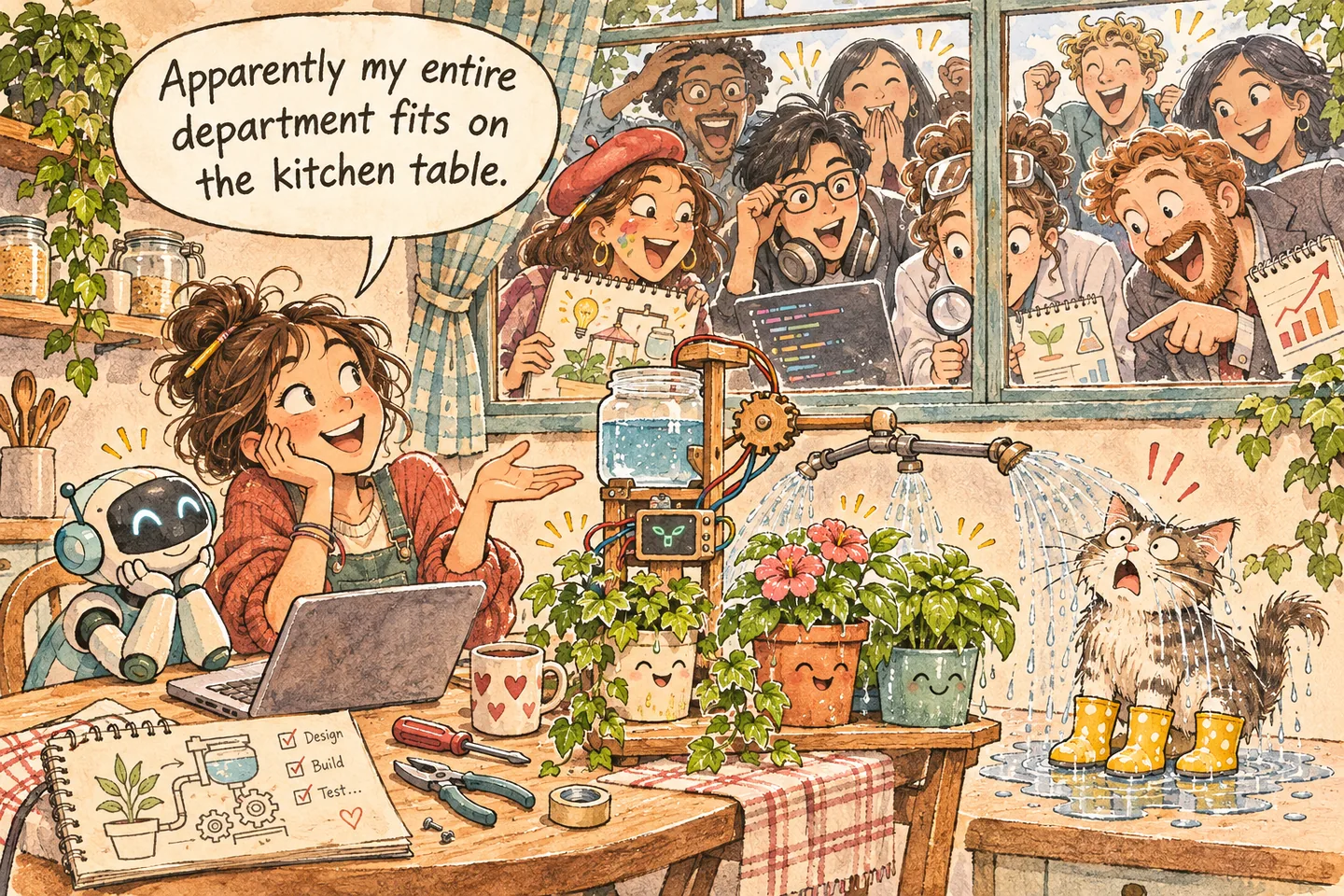
Let the child choose something worth making
Curiosity supplies a reason to learn.
A child who loves stories might create an illustrated adventure and revise it after a younger sibling gets confused. A teenager might build a simple game, a plant-care reminder or a tool for organising the family’s hobby equipment.
Start with an idea they care about. Ask who it is for, what it should do, and how they will know whether it works. Make a small version. Let someone try it. Fix what fails. Keep the child involved in choosing, explaining and improving.
In our cartoon, the plant-watering invention has also watered the cat. That is an excellent moment to learn about testing, unintended consequences and why the customer has claws.
Parents do not have to master every tool before joining in. “I don’t know; let’s investigate” is a useful example to set. So is “That answer sounds convincing, but how can we check it?”
Nothing here requires turning childhood into a startup competition. Play, friendships and ordinary off-screen experiences matter too. A small project can simply give a child the satisfaction of making an idea real.
Adults get to use the kitchen table too
Opportunity becomes valuable when it solves somebody’s problem.
The same principle applies to earning a living. Someone who notices a recurring problem and learns to solve it can create a useful service, tool or product. AI may help them attempt work they could not previously deliver.
But a clever demonstration is not automatically a business. People must want the result, trust it and find it useful enough to pay for. Customer conversations, reliable delivery and persistence still matter. This is the practical meaning of execution turning an idea into value.
I am optimistic about the expanding range of things individuals can attempt. That is a perspective on opportunity, not a promise that making money is easy or that every person faces fewer obstacles than previous generations.
Nor should we assume that expensive formal education is the only respectable doorway. A degree remains valuable in many situations and essential for some careers. Alongside that route, demonstrable skills, useful projects, apprenticeships and work experience can show what a person can actually do. AI can help people learn and build evidence of their ability; it cannot award the professional qualifications a role requires.
The question becomes broader than “Which credential should I acquire?” It also includes “What problem can I learn to solve, and how can I demonstrate that?”
A half-full glass still needs someone to pick it up
Optimism is most useful when it leads to action.
Fear of dependency identifies something worth managing. It need not become the whole story we tell our children about AI.
A productive glass-half-full view says: here are tools that could help you understand more, explore more and create more. Let’s learn to use them with judgment. That connects to optimism creating energy: possibility gives us a reason to take the next useful step.
How we use AI matters enormously, though tool design, teaching, access and supervision matter too. Choose uses that require the learner to remember, explain, question, decide and test. Then look for an ambition the tool makes newly approachable.
- Learn one thing. Study a topic, close the material, and ask AI to quiz you. Check the feedback and explain what you learned without help.
- Make one thing. Pick a small idea you care about. Use AI to help create a first version and test it with someone.
- Notice the difference. What can you now understand or accomplish that you could not before?
You can try this with your child, in your own work, or with an idea that has been sitting on the shelf for years.
Alongside asking what AI might stop your children from learning, ask what it could finally give them the chance to do.
Sources and perspective
Evidence about learning; a practical argument about opportunity.
Karpicke & Roediger (2008), The Critical Importance of Retrieval for Learning, Science, studied repeated retrieval and delayed retention. Karpicke & Blunt (2011), Retrieval Practice Produces More Learning than Elaborative Studying with Concept Mapping, Science, examined learning from educational science texts. These studies support retrieval practice; they are not trials proving that today’s AI tutors improve children’s general cognition.
The AI coaching routine is a practical application of that learning principle. The discussion of creativity, education and opportunity expresses Tim Barrie’s perspective, not a forecast of individual earnings. Developed with AI assistance. Cartoons are fictional illustrations, not depictions of an actual family.